Introduction
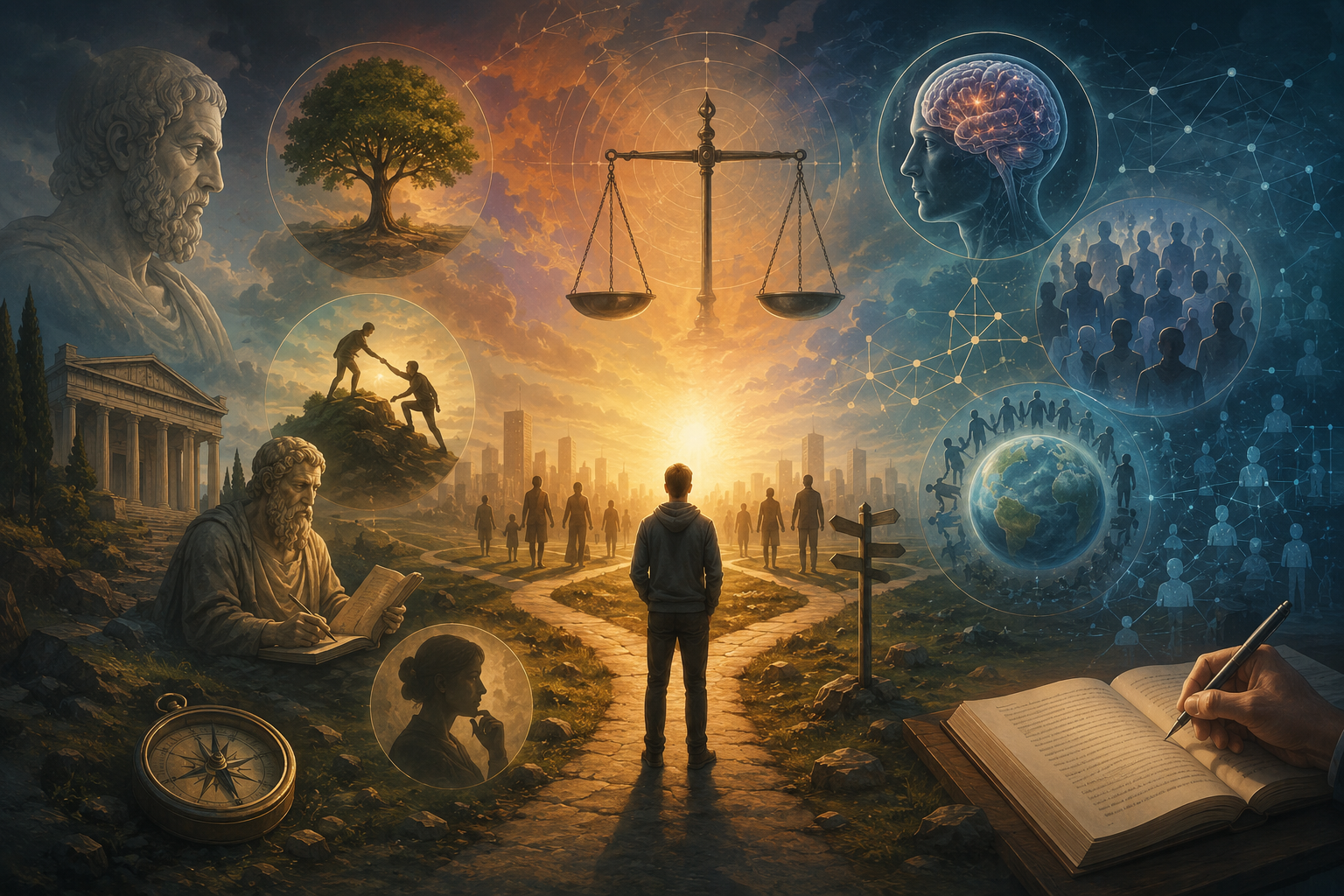
Morality is something everyone uses, even if we don’t always notice it. It shows up when we judge actions as right or wrong, when we feel guilt or pride, and when we decide how to treat others.
But what is morality really? Where does it come from, and why do humans have it at all?
There isn’t one simple answer. Different fields; philosophy, psychology, and evolutionary biology, describe morality in different ways. This makes morality less like a fixed definition and more like a concept seen from multiple perspectives.
This article is a basic introduction to those perspectives.
What is morality?
At its core, morality refers to the system humans use to distinguish right from wrong and to guide behavior in social life. But depending on how it is understood, morality can mean very different things: biological tendencies, rational principles, cultural norms, or even objective truths.
To make sense of this, it helps to look at several major approaches.
1. Evolutionary & Psychological
In evolutionary psychology, especially in the work of scholars like Dennis L. Krebs, morality is seen as something that developed because it helped humans survive in groups.
It can be described as:
“a set of evolved psychological tendencies that regulate social behavior. Especially cooperation, altruism, self-control, and punishment of antisocial behavior.”
In The Origins of Morality, Krebs argues that morality is rooted in mental systems shaped by evolution that make group living possible, including emotions like guilt, empathy, and indignation.
In simple terms, morality may come from natural human instincts that support cooperation and social order.
2. Moral Realism
A pilosophical tradition, including thinkers like Plato. Moral realism holds that morality is not just opinion or biology. It argues:
“Moral truths exist independently of what people think.”
From this perspective, statements like “murder is wrong” are true or false in an objective sense, regardless of cultural beliefs or individual preferences.
3. Utilitarianism
Utilitarianism, developed by Jeremy Bentham and later refined by John Stuart Mill, defines morality in terms of consequences.
“The morally right action is the one that produces the most happiness or well-being for the greatest number of people.”
Here, morality is about maximizing overall good outcomes and minimizing suffering.
4. Virtue Ethics
The ancient philosopher Aristotle proposed a very different view. Instead of focusing on rules or consequences, he focused on character:
“Morality is the cultivation of virtuous character traits that lead to human flourishing (eudaimonia).”
Virtues like courage, honesty, and moderation define what it means to live a good life. The key question becomes not just “What should I do?” but “What kind of person should I become?”
This idea is closely echoed in Stoic philosophy, where thinkers like Epictetus, Seneca, and the Roman emperor Marcus Aurelius emphasized the cardinal virtues of wisdom, courage, justice, and self-discipline (temperance) as the foundation of a good life. In this view, morality is not mainly about rules or outcomes, but about training the mind and character to respond to life with reason and virtue.
5. Social Contract Theory
Social contract theory was developed by thinkers like Thomas Hobbes and later Jean-Jacques Rousseau. It suggests:
“Morality is a set of rules rational individuals would agree to in order to live together peacefully and cooperatively.”
For Hobbes, this contract arises from the need to escape chaos and conflict. For Rousseau, it is more about collective freedom and cooperation. In both cases, morality is grounded in agreement rather than divine authority or natural law.
6. Moral Relativism
Moral relativism is often associated with anthropologists like Franz Boas. It holds:
“Morality depends on cultural or individual perspectives, not universal truths.”
What is considered right or wrong varies across societies, and no single moral system is universally correct.
7. Kantian ethics
The philosopher Immanuel Kant proposed a rule-based approach to morality. A simple interpretation is:
“Only act in ways that you would accept as a rule for everyone.”
For Kant, morality is not about outcomes or feelings, but about rational consistency and universal principles. If an action cannot be applied fairly to everyone, it is not moral.
Difference between Morality and Ethics
Although the terms are often used interchangeably, morality and ethics can be distinguished. Morality refers to the personal or cultural beliefs people hold about what is right and wrong, while ethics is the systematic philosophical study of those beliefs.
In simple terms, morality is what people believe, whereas ethics is the reflection on those beliefs. Practically speaking, morality is concerned with questions like “How do I live a good life?”, while ethics asks “Why do I think this way is good in the first place?”
Why Morality Matters
Morality matters because it plays a fundamental role in how humans live together. It helps reduce conflict, build trust, support cooperation, and create stable societies. Without some shared sense of moral understanding, large-scale social life would become extremely difficult to sustain.
Morality and Truth
One of the deeper philosophical questions surrounding morality is whether it is connected to truth. Are moral statements objectively true or false in the same way scientific claims can be, or are they simply expressions of culture, biology, or personal preference? This remains a central issue in philosophy and is worth exploring in greater depth separately.
Conclusion
Morality is not a single idea with one definition. It can be understood in multiple ways: as evolved instincts (Krebs), objective truths (moral realism), consequences (Bentham and Mill), virtues (Aristotle), social agreements (Hobbes and Rousseau), cultural systems (Boas and relativism), or universal rational rules (Kant). Each perspective highlights something different about human behavior and society.
Rather than choosing one definition, morality may be best understood as a layered concept, one that reflects both human nature and human thought.
What perspective resonates most with you?