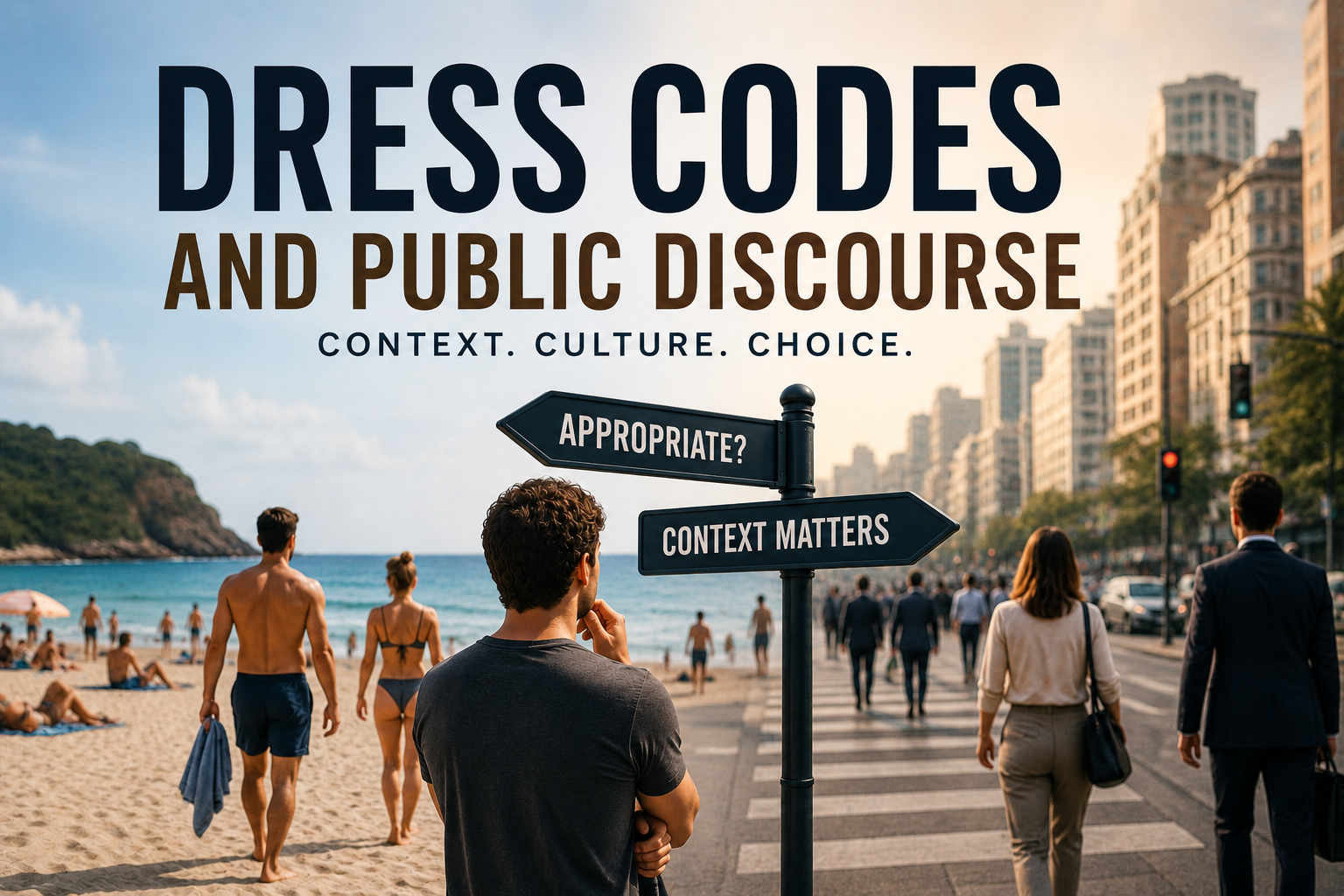
Introduction: A Social Mirror
Inspired by a warm summer afternoon in the park, I found myself reflecting on a surprisingly persistent topic: how we dress in public.
Humans are highly social creatures. We do not merely act; we also reflect on how our actions are perceived by others. Our consciousness functions partly as a social mirror, allowing us to imagine how our behaviour, appearance, and clothing affect the reactions of the people around us. The way we dress is one of the most visible expressions of this process.
Because clothing is visible to everyone, discussions about clothing often become moral discussions. Without becoming overly philosophical, we can observe that people regularly make judgments about appearance. Some forms of dress are considered appropriate and are met with approval, while others are viewed negatively and provoke criticism. In short, some choices make us cheer and others make us boo. Yet these reactions are not simply a matter of approval or disapproval. Clothing can evoke admiration, attraction, respect, comfort, discomfort, embarrassment, irritation, or even outrage. The public discussion around dress codes is therefore not merely about fabric covering skin; it is about the emotions, values, and expectations we attach to what people choose to wear.
This immediately raises an important question:
why do these judgments change so dramatically from one situation to another?
Why Context Matters
What is considered appropriate depends heavily on context. A shirtless man on the beach is generally unremarkable, while the same person walking shirtless through a city centre may attract disapproving looks. Context exists at multiple levels. On the micro level, the immediate environment matters: a beach, a park, a religious building, or a business meeting each carry different expectations. On the macro level, broader cultural values and societal changes shape what is considered acceptable.
The key lesson is that clothing rarely has meaning on its own. The same outfit can be perceived as respectful, practical, provocative, or completely ordinary depending on where, when, and by whom it is observed. Public dress codes are therefore not fixed rules but contextual agreements between individuals and the communities they participate in.
Sexual Modesty
One recurring theme in discussions about dress is sexual modesty. Many cultures have developed norms around covering body parts associated with reproduction and sexuality, activities generally viewed as belonging to the private sphere. Particular attention is often given to female breasts, which remain the subject of ongoing debate. Whether male and female toplessness should be treated differently depends on cultural values, biological considerations, and competing moral intuitions.
Sexual modesty is such a persistent topic because it sits at the intersection of several powerful human concerns: sexuality, reproduction, family life, religion, personal freedom, and social order. Few topics carry as much emotional and cultural weight. As a result, debates about dress codes often become debates about much larger questions concerning the kind of society people wish to live in.
Between Dressed and Undressed
At its core, public debate about clothing revolves around a simple spectrum. At one end is complete coverage, where almost nothing of the body is visible. Examples can be found in certain religious settings where individuals cover nearly their entire body and face. At the other end is complete nudity, where nothing is concealed. Most cultures establish their own norms somewhere between these two reference points, although where they draw the line varies considerably.
For the sake of imagination, I have occasionally posed the question: if someone is wearing nothing except a baseball cap, are they dressed or naked? The question usually produces laughter before it produces an answer. Yet it illustrates an important point. The boundary between “dressed” and “undressed” is often less obvious than we assume. Most disagreements occur not at the endpoints themselves, but in the vast middle ground between them.
The exact position of that middle ground varies across cultures, environments, and historical periods, but a general consensus usually emerges regarding what is considered appropriate.
Revisiting the Consensus
That consensus deserves respect because it reflects shared social expectations. At the same time, it should never be immune to criticism. Healthy societies periodically re-examine their norms and ask whether they still serve a useful purpose. As contexts change, so too may the values and assumptions that underpin dress codes.
The practical lesson is simple: when discussing how people should dress in public, it is rarely helpful to think in absolutes. Dress codes are not fixed laws of nature. They are social agreements shaped by culture, context, and changing attitudes. Understanding this makes public debates about clothing less about outrage and more about understanding why certain norms exist in the first place. And if we occasionally find ourselves debating whether a person wearing only a cap is dressed or naked, perhaps that simply reminds us how much of the discussion depends on social interpretation rather than objective fact.
Discussion Question
If you believe some of today’s dress codes no longer reflect today’s society, what would be the most constructive way to change them?