Introduction
Culture changes constantly.
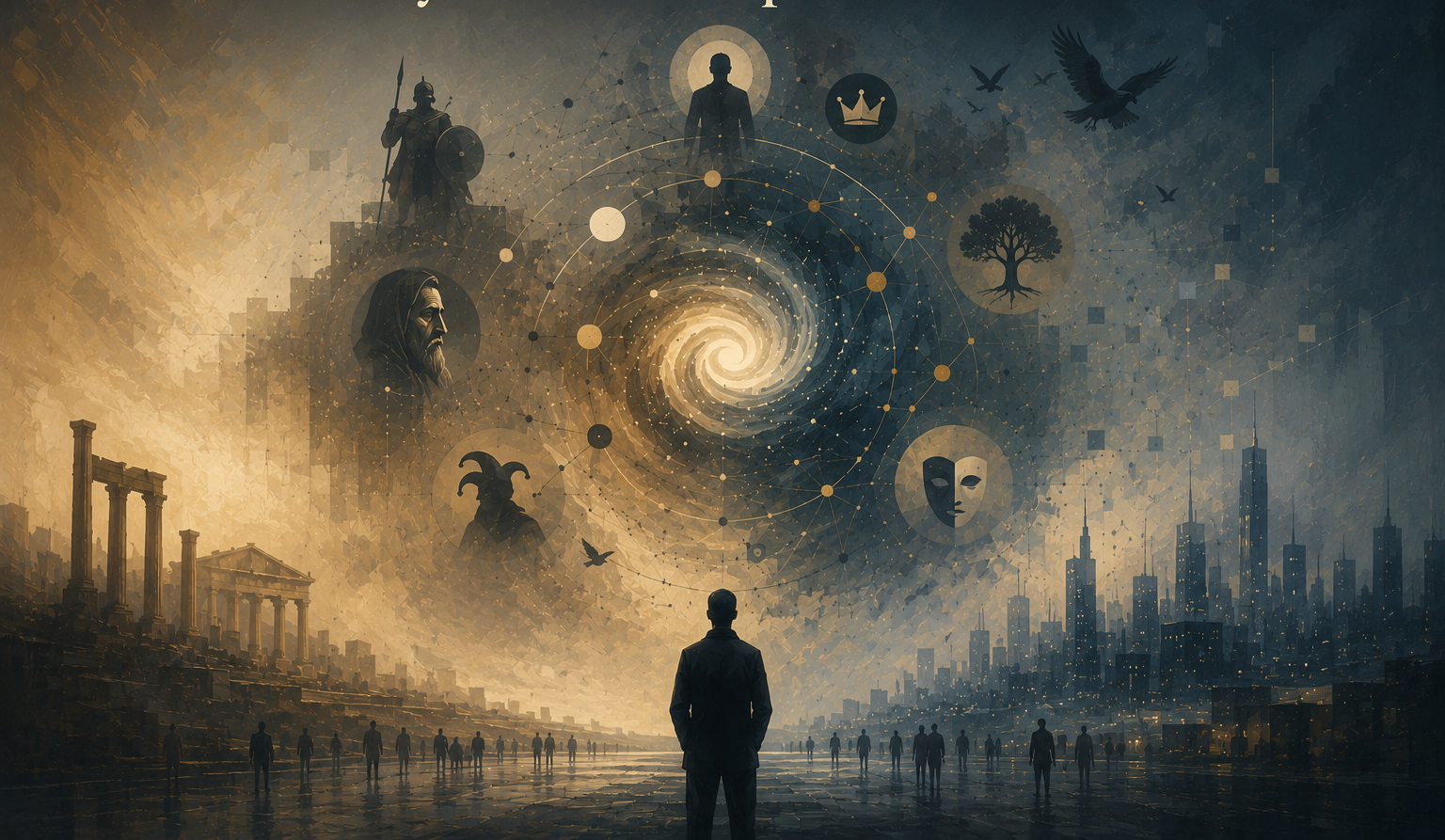
New ideas emerge, spread, and disappear. Technologies reshape how people communicate. Political movements rise and fall. Entire belief systems can lose influence within a few generations. Yet beneath this constant change, certain patterns seem remarkably persistent.
Stories of heroes, rebels, tricksters, visionaries, and villains continue to reappear. Narratives surrounding order and chaos, belonging and exclusion, progress and decline repeatedly emerge in new forms. The symbols change, but something about the underlying patterns appears surprisingly stable.
This observation raises an interesting question. If culture is continuously evolving, why do certain symbolic structures keep returning?
One possible answer can be found in memetics, the study of how cultural information spreads and evolves. While memetics is often associated with internet memes, its scope is much broader. It attempts to understand how ideas, behaviors, beliefs, symbols, and narratives replicate through culture.
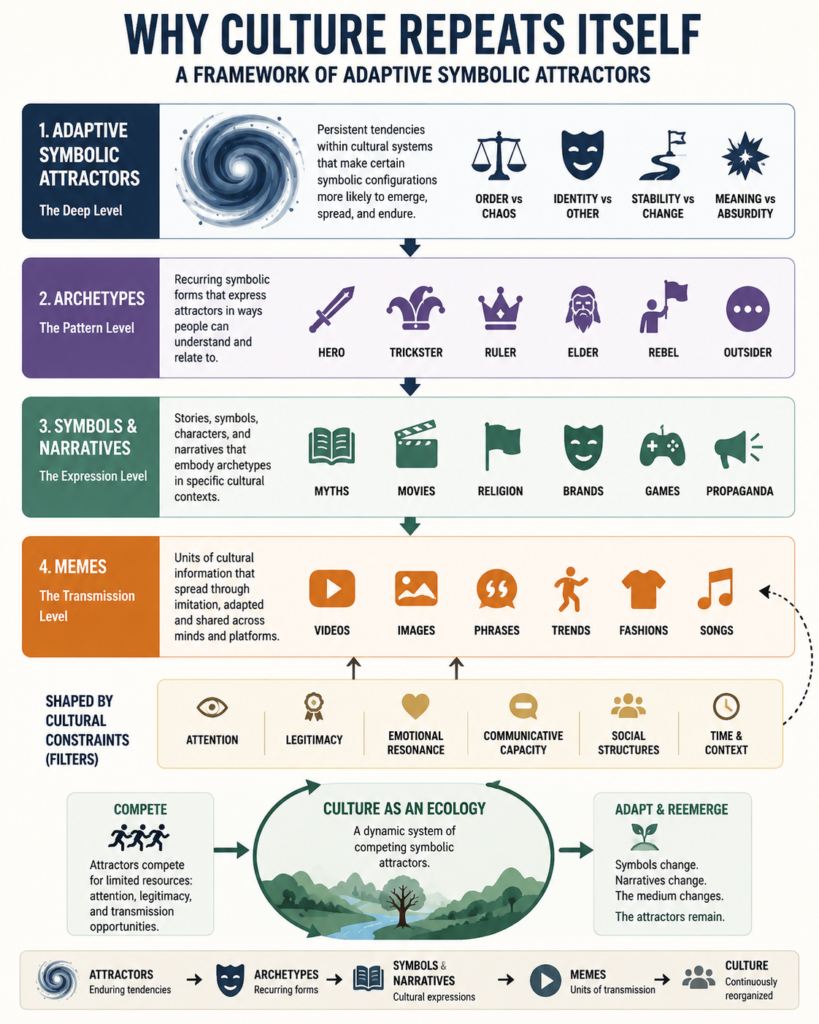
In this blog, I explore the possibility that some recurring cultural patterns can be understood as adaptive symbolic attractors: persistent tendencies within cultural systems that repeatedly generate recognizable symbolic forms. Drawing from memetics, archetypal patterns and systems thinking, I will argue that culture may be understood not merely as a collection of ideas, but as an ecology of competing symbolic structures that continuously adapt to changing environments.
Memetics
The concept of memetics originates from Richard Dawkins’ book The Selfish Gene. In Chapter 11, Dawkins introduces the term meme as a unit of cultural transmission. If genes are biological replicators that pass information through reproduction, memes can be understood as cultural replicators that pass information through imitation. Ideas, beliefs, stories, rituals, fashions, songs, phrases, and social practices can all function as memes. Whenever one person adopts something from another person, cultural information is being transmitted.
Memetics therefore provides a useful lens for understanding cultural evolution. Cultural evolution refers to the process through which ideas, beliefs, behaviors, symbols, and social practices spread, mutate, and compete over time. Just as biological evolution operates through variation, selection, and inheritance, cultural evolution operates through the transmission and adaptation of information between individuals and groups.
Yet it also raises an important question. If countless memes are constantly being created, why do only a small number achieve widespread adoption while most disappear unnoticed? The internet provides an excellent environment for exploring this question.
Online Memes
For many people, the word meme immediately evokes images and videos shared online. In recent years, a particularly strange category of internet culture has emerged under the label brain-rot. For readers unfamiliar with the term, brain-rot originally emerged as a tongue-in-cheek way of describing media so repetitive, absurd, or overstimulating that it appears to metaphorically “rot the brain.”
One of the most recognizable examples is the phenomenon known as Italian Brainrot.
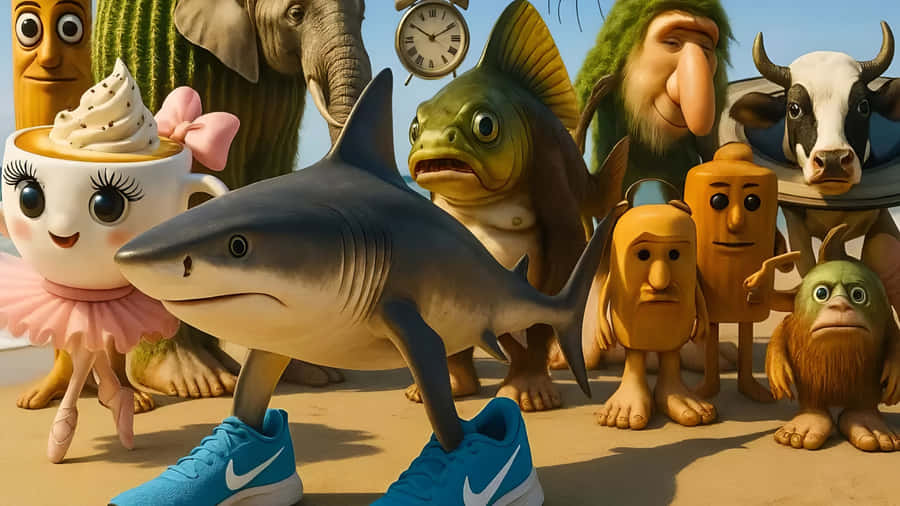
Italian Brainrot demonstrates what highly successful memetic transmission looks like. The content spreads rapidly through imitation, repetition, novelty, and social participation. New variations emerge continuously as users copy, modify, and redistribute existing material. What begins as a niche internet joke can eventually become so widespread that people encounter it outside the platforms where it originated.
Yet something interesting happens.
Despite its explosive growth, Italian Brainrot already appears to be fading from public attention. The characters remain recognizable for a while, merchandise appears in stores, and fragments linger within internet culture, but the cultural spotlight inevitably shifts elsewhere. New memes emerge, old ones lose momentum, and the cycle repeats itself.
This suggests that successful transmission alone is not enough to guarantee long-term survival. Some memes spread rapidly and disappear. Others persist for generations. To understand why, we must look beyond transmission itself and examine the symbolic structures that memes carry.
Symbolism
Across cultures and throughout history, humans have repeatedly organized experience through symbolic patterns. Heroes and villains appear in stories separated by oceans and centuries. Societies repeatedly construct ideas around order and chaos, wisdom and foolishness, belonging and exile, progress and tradition. Although the symbols themselves differ, the underlying patterns often remain remarkably similar.
Humans do not merely exchange information. We exchange meaning.
A national flag represents more than colored fabric. A wedding ring represents more than metal. A religious ritual communicates more than a sequence of actions. Symbols act as compressed packages of meaning that carry emotional, social, and behavioral information. From a memetic perspective, symbols are powerful because they allow complex ideas to spread efficiently. The symbol becomes a vehicle through which larger patterns can replicate across minds.
This observation raises an intriguing possibility. Perhaps some memes survive not because of their specific content, but because they attach themselves to deeper symbolic patterns that repeatedly emerge throughout human history.
Archetypes as Functional Patterns
The concept of archetypes is often associated with Carl Jung and the idea of a collective unconscious. Whether one accepts Jung’s interpretation or not, there is a more practical observation worth considering. Certain symbolic patterns appear repeatedly across cultures.
Stories consistently generate heroes who confront danger, elders who preserve wisdom, rebels who challenge authority, and tricksters who disrupt established norms. The names change, the costumes change, and the cultural context changes, yet the underlying similarities remain recognizable.
For the purposes of this discussion, archetypes can be understood as recurring symbolic forms rather than mystical entities. They are symbolic structures that repeatedly emerge across cultures and historical periods. Importantly, the archetype is not the symbol itself. The symbol is merely one expression of a deeper pattern. This distinction becomes particularly useful when examining modern internet culture.
The Digital Trickster
Brain-rot memes frequently reject coherent narrative, collapse seriousness and irony into the same space, embrace randomness, and transform confusion itself into entertainment. Their humor often emerges not from clarity but from disorientation. Rather than preserving meaning, they distort it. Rather than reinforcing conventions, they violate them. Rather than maintaining order, they create disruption.
In this sense, brain-rot memes resemble one of humanity’s oldest symbolic patterns: the Trickster. Throughout history, trickster figures have appeared in many forms. Norse mythology gave us Loki. Greek mythology gave us Hermes. Many Indigenous traditions contain coyote figures who disrupt order through deception and mischief. Medieval Europe developed the court jester, a character capable of speaking uncomfortable truths through humor and absurdity. Although these figures belong to very different cultures, they display remarkably similar characteristics. They challenge conventions, blur boundaries, expose contradictions, and create novelty through disruption.
Brain-rot memes appear to operate in much the same way. The meme can be interpreted as a digital trickster. It mutates meaning, derails expectations, and transforms confusion into participation. Viewed through this lens, the meme is not simply random entertainment. It becomes a contemporary expression of a much older symbolic pattern.
Symbolic Attractors
This brings us to the concept of attractors.
In systems thinking, an attractor refers to a state or pattern toward which a system tends to organize itself over time. Rivers carve valleys, ecosystems settle into recurring configurations, and markets often display recognizable patterns despite constant fluctuations among individual participants. Cultural systems may exhibit similar tendencies.
Throughout history, societies have produced an astonishing variety of symbols, narratives, beliefs, and institutions. Yet beneath this diversity, certain patterns appear with remarkable persistence. Heroic figures emerge in different civilizations. Tricksters repeatedly appear in myths, stories, and popular culture. Narratives surrounding order, chaos, belonging, sacrifice, progress, and decline continuously reappear in new forms. The interesting question is not whether these symbols are identical. Clearly they are not. The interesting question is why entirely different cultures repeatedly generate patterns that appear structurally similar.
One possible explanation is that cultures contain recurring symbolic attractors.
These attractors are not specific stories, characters, or archetypes. Rather, they are persistent tendencies within cultural systems that make certain symbolic configurations more likely to emerge, spread, and endure. From this perspective, archetypes can be understood as visible expressions of deeper attractors. The Trickster, for example, may not be the attractor itself but one of many possible manifestations of a recurring tendency toward disruption, boundary-crossing, novelty, and the destabilization of established meaning. Likewise, heroic figures may emerge as one expression of broader attractors related to status, aspiration, sacrifice, or collective identity.
This shifts the focus away from individual symbols and toward the underlying patterns that repeatedly generate them. The recurrence itself becomes the phenomenon requiring explanation.
Yet there is still a problem.
If attractors help shape cultural evolution, why do they persist at all? Technologies change, institutions rise and fall, and entire civilizations disappear. One might expect symbolic patterns to become obsolete alongside the environments that produced them. Yet they continue to reappear. The symbols change. The narratives change. The medium through which they spread changes. Something deeper appears to persist. To understand why, we must add one final ingredient.
Adaptation.
Adaptive Symbolic Attractors
The word adaptive adds an important evolutionary dimension. A symbolic attractor survives not because its specific form remains unchanged. It survives because it continuously changes while preserving aspects of its underlying structure.
Consider the Trickster once more. Across history it appears as Loki, Hermes, the court jester, carnival traditions, satirical comedians, internet trolls, and contemporary brain-rot memes. The symbols, technologies, and narratives differ dramatically, yet recognizable similarities remain. The Trickster disrupts established patterns, challenges conventions, and introduces novelty into otherwise stable systems.
What persists is therefore not the symbol itself but the recurring pattern carried by the symbol. Cultural evolution rewards symbolic patterns that successfully adapt to changing environments. An archetype survives because cultural evolution continuously generates new symbolic expressions that remain compatible with the underlying attractor. The symbol mutates. The pattern remains. Seen from this perspective, culture contains a population of adaptive symbolic attractors competing to maintain relevance within an ever-changing environment.
Competitive Ecology
If adaptive symbolic attractors exist, they do not exist in isolation. They compete. Because attention, legitimacy, emotional resonance, and opportunities for transmission are finite, where “finite” refers to the bounded nature of human cognitive capacity, social trust allocation, and limited communicative bandwidth, symbolic patterns inevitably compete with one another. Every culture contains numerous symbolic patterns attempting to establish themselves within the minds of individuals and the structures of society.
Different environments favor different attractors. Periods of stability often reward symbols associated with order, hierarchy, tradition, and institutional legitimacy. Periods of uncertainty may reward symbols associated with innovation, rebellion, disruption, and experimentation.
From this perspective, cultural change can be understood not merely as a sequence of random trends but as an ecological process. Adaptive symbolic attractors compete for attention, legitimacy, and opportunities for transmission, while their symbolic expressions continuously adapt, mutate, and recombine. Over time, attractors are stabilized, weakened, or transformed through the cumulative success or failure of these expressions. Some attractors persist by repeatedly reconfiguring to remain viable under changing conditions.
Closing
If there is any value in viewing culture through this lens, it is that it shifts the question from which ideas survive to why certain kinds of ideas keep coming back.
Memes rarely persist in their original form. They mutate, fragment, merge with other ideas, and adapt to new environments. Most eventually disappear. Yet some symbolic patterns seem remarkably difficult to get rid of. Not necessarily as the same stories, symbols, or characters, but as recognizable patterns expressed through new cultural forms.
From this perspective, cultural persistence is not primarily about preserving specific ideas. It is about the repeated re-emergence of similar symbolic patterns under changing conditions. This is what I mean by an adaptive symbolic attractor.
An adaptive symbolic attractor is not a symbol, a character, or an archetype. It is a recurring tendency within culture that makes certain symbolic forms more likely to emerge, spread, and persist. The attractor remains relatively stable while the symbols expressing it continuously change.
Yet the broader pattern it appears to express may not disappear in the same way. The meme fades. The pattern returns. Future generations may invent entirely different symbols, characters, and narratives, but the tendency toward disruption, absurdity, novelty, and boundary-crossing may continue to reappear in new forms.
The symbols change.
The archetypes adapt.
The attractors remain.
If this perspective is correct, cultural history is not simply a collection of surviving ideas. It is an ongoing process through which recurring symbolic patterns continuously reorganize themselves within changing cultural environments.